Tuesday, September 25, 2007

The Emir's Guard

NCP200686085  01

Ludwig Deutsch
The Emir's Guard (Le Garde de l'Émir)1893
oil on canvas

Sunday, September 9, 2007

Mosque - La Pri'ere au Tombeau


by Ludwig Deutsch (Austrian Orientalist, 1855-1930)
signed and dated ' Le Caire 1898"
oil on panel 27 x 23.38 in (68.5 x 59.5 cm)

Deutsch painted the tomb chamber at the Aqsunqur Mosque in Cairo. The mosque was originally built in 1346, but received a major renovation in 1652. This is when the Ottoman blue tiles were added, hence the name " Blue Mosque".

Images of piety and prayer were depicted by many of the Orientalist painters. Unlike European churches that often were decorated excessivly, the interior of a mosque was a rather empty, spacious environment adorned mainly by intricate tilework.

In this work Deutsch has given us a sense of the spaciousness of the mosque through the use of the many vertical elements in the picture. To anchore the main figure, he has chosen to place him between the two vertical columns of the tomb and cleverly framed him, by starting the tile work on the back wall at the same level of the columns.

His color choice for the garment is also intersting. The vibrant red is a nice compliment to the blues and sets his main figure apart from the surroundings.

Wednesday, September 5, 2007

The Answer

The Answer

The Answer

signed and dated "L. Deutsch 1883" upper left
oil on panel
18 z 11 3/4 in (45.6X 29.8 cm)

This painting shows architectural influences from his first trip to Egypt in 1883, Damascus and the Ottoman Empire.

This work is a masterpiece in observation and execution. Deutsch painted with a hairline brush to capture every minute detail, weather it is on the body of the men, the garments, props or architectural elements. When compared to a smaller study for this work one can see that Deutsch has given much thought to improve the composion. He added visual interest by changing the pattern of the marble floor tiles from that of a rather heavy, two tone chess board pattern to a lighter diamond shape pattern. This change along with the light pattern on the stairs creates a light infused atmospere in the room.

He has taken artisitc liberties with the 17th century Syrian tiles behind the servant. These tiles would have been laid on the floor rather than on the wall.

"Ceramic tiles from Iznik, Diyarbakir and Damascus all depict flower scrolls, which are symbols in Islam for intellectual growth and God's continues presence in nature. Although large groupings of such scrolls produced by four, six, or eight tiles were repeated throughout even larger designs, individual tiles were not repeated in purely geometric patterns. The tile grouping, therefore appears to be based on a single tile that might have been in his private collection. Chritistie's Catalog Oct. 2001, P. 24


Ludwig Deutsch had collected many props on his travels and he used the in many of his paintings. Here a 18th Century Turkish tombak ewer and basin on a 19th Century mother of pearl table and a 19th Century indo Persian shield act as props to lighten up and add interest to the corner.

The main figure, the Chieftain wears a beautifully Salmon colored Balkan robe, which is greatly embellished with beads. The high contrast of the pale pinks against the dark skin of the figure just make him visually pop out from the muted dark background. Deutsch understood that in order to improve this painting the colors had to be more intense and required greater contrast.

Sunday, September 2, 2007

The Scribe

The Scribe by Ludwig Deutsch

Artist: Ludwig Deutsch
Title: The Scribe (le Scribe) 1911
Signed lower left L. Deutsch 1911
Medium:Oil on panel /huile sur panneau
Size: 50.8x36.8cm

Monday, August 20, 2007

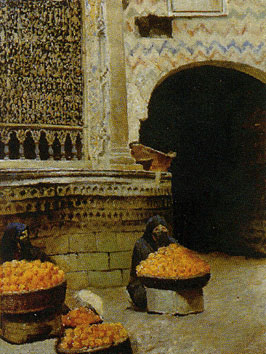
The Orange Sellers, Cairo


signed , inscribed and dated 'L. Deutsch Paris 1886'
painted in 1886
Oil on panel
20.5 x 16 in (52 x 40.7cm)

Like his sumptuous interior scenes, Ludwig Deutsch's renditions of the street life of Cairo were bravura exercises in the detailed rendition of surface textures, artfully composed from the artifacts and sketches he brought back to his studios. However, Deutsch was equally fascinated by the compositional possibilities afforded by everyday encounters between small crowds and a central figure-weather street vendors (fig.1), snake charmers or healers.

In the present work Ludwig Deutsch focuses on the two central figures of the orange seller and the buyer. In addition, the piles of oranges painted with a startling saturated, cadmium-based paint immediately succeed in locking the viewer's attention on the picture plane. This daring use of color in 1886 is a precursor to the brightly colored The Palace Guard of 1892.

In the Orange Seller, Cairo, the costume of the female figure offering an orange to the standing man is the same dress and head coverings as that of the sitter in The Sahleb Vendor, Cairo, 1886 (fig2.), but here she is seen with her back to the viewer on the right. This repetition of objects and textiles in Deutsch's work is typical and frequent.

Often these pieces belonged to the artist and he was able to reuse them in numerous compositions. In addition, Deutsch also collected photographs of exotic objects in his archives and he would draw upon these frequently.

A preparatory oil sketch for the present painting titles Marchande d'oranges(fig.3)

reveals that compositionally Deutsch experimented with the placement of the baskets of oranges as well as the positioning of the central figure of the orange seller prior to settling on this final composition. Some changes have been made: in Marchande d'oranges both ladies are wearing the traditional veil, whereas in the The Orange Seller the female sitter has removed her veil. This adjustment to the final composition enhances the interaction between the man and the female merchant thereby heightening the human drama.

Source: Christie's Orientalist Art 2005 P.16

Biography

1855 born in Vienna, Austria.
1872-1875 After high school, he entered the Academy of Fine Arts to study Classical painting with Anselm Feuerbach (1875-1877)
1877 When Feuerbach retired as a teacher, Deutsch and some others students attempted to enter the class of Leopold Carl Müller, who had moved to Paris in 1876, but were refused entry.
- 1878 Deutsch was accepted.
- 1880 Deutsch breaks his contacts with Vienna
- 1894 after making a name for himself in Paris he showed "The eunuchs"at the Künstlerhaus in Vienna.
- Deutsch continued his studies while taking lessons with the history influential painter Jean-Paul Laurens. Jean-Paul also introduced his most gifted students to Parisian buyers.
- He established his own studio at Rue Le Pelletier in Paris.
- 1879 Deutsch entered for the 1st time a portrait in the Salon competition.
- 1880 "Dona Joan Bohorques, Agony of the Inquisition was shown. A piece that suggest the influence of Laurens.
- 1881 His first recorded Orientalistes painting is created
- 1882 Painting of 'The Domino Players' completed (Die Dominospieler (les joueurs de dominos
- 1883 he exhibits a now lost piece to the Salon of French Artists under the title "An Orientalist Amateur.
- 1883 Painting of 'The Musician' completed
- 1883 Painting of 'The Answer'completed
- During this time Deutsch's work goes through an evolution. Although the subjects remain almost the same, he slowly turns from group paintings to that of capturing unique characters, from depicting secular places to that of beautiful palaces and places of worship.
- 1885 Deutsch found a new studio. During his career he was to have several studios throughout Paris and the South of France. He kept a vast amount of objects collected during his travels, such as tiles, furniture, arms, pipes, fabrics, and costumes. Like many of his contemporaries, the artist made use of photography to ensure archaeological accuracy in his painted renderings of local architecture, tile and ablaq stone work, and the traditional mashrabiyyah woodwork. This time also marked an era of great productivity and forays into a post-impressionistic style. Always the perfectionist, his work is characterized by exact attention to detail.
- 1885 Painting of A Sentinel completed
- 1885 Painting of 'News from Sudan'completed
- 1886 Deutsch traveled to Egypt for the 1st time
- 1886 Painting of 'The Orange Sellers'completed
- 1886 Painting of The Sherbert Vendor completed
- 1887 Painting of 'The hour of Prayer'completed
- 1888 Painting of "Snake Charmers'completed ("Snake Charmers" - Die Schlangenbeschwörer (Les charmeurs de serpents) shows a lively looking group of people)
- 1890 Deutsch traveled to Egypt for a 2nd time. These trips allowed him to gather subjects and motif for his work. Just like his friend Rudolf Ernst, Deutsch enlisted photographers from photography studios in Cairo.
- 1890 Painting of 'Court of El Azhar University, Cairo' completed
- 1891 Painting of The Healer completed
- 1892 Painting of The Palace Guard completed
- 1893 Painting of 'The Emir's Guard' completed
- 1893 Painting of The Palace Guard completed
- 1894 Painting of The Scribe completed
- 1896 Painting of The Scribe completed
- 1896 Painting of 'Chess Players' completed (Les Joueurs d'échecs)
- 1897 Painting of The Philosopher completed
- 1898 Deutsch traveled to Egypt for a 3rd time
- 1898 Painting of 'Prayer at the Tomb'completed
- 1900 Painting of Palace Guard completed
- 1900 Painting of 'Leaving the Mosque'completed
- 1900 Won the Gold Medal at the Paris Salon in Paris for being a prolific painter for forty years.
- 1901 Painting of The Learned completed
- 1902 Painting of Interior of Mosque completed
- 1902 Painting of Palace Guard completed
- 1903 Painting of 'The Harem Watchman'completed
- 1906 Painting of Morning Prayer completed
- 1906 Painting of 'The Narghil Smoker'completed
- 1911 Painting of The Scribecompleted
- 1914 With the break out of the First World War, he was forced to leave Paris.
Although his whereabouts during this time are not know, it is recorded that he did travel to North Africa for a time.
- 1919 At the first after war Salon he had obtained French citizenship and started to sign his name as Louis Deutsch
- 1923 Painting of At Prayer completed
- 1927 Painting of The Fortune Teller completed
- 1932 Painting of Musical Interlude 1932 completed
- 1935 Unmarried and withdrawn from the world, he died on April 9th 1935 in Paris
It is said that Rudolf Ernst remained one of his closest friends.

? Market Scene
? Sharia El Sanadkyeh
? Before Prayer
? An Arab with his Servant
? Sahleb Vendor
Ludwig Deutsch, always the perfectionist has throughout his career aimed to perfect his photo realistic technique and to offer variety through the sparkling ways he has treated his canvases. Despite the exactness in the details, there is also evidence that he aimed to convey cultural relevance. Some thing do repeat within the different paintings, such as certain accessories and models, who without doubt were Arabs or Africans living in Paris. One can wonder if some of the Eastern compositions of Ludwig Deutsch were not entirely workshop inventions, yet the colors of the architectural details are in accordance with reality and leave no doubt that he has been influenced by his observations in the East.

Wednesday, August 8, 2007

The Scribe


The Scribe
Artist: Ludwig Deutsch (Austrian, 1855-1930)

Signed and dated Paris 1896
Medium: Oil on panel/ huile sur panneau
Size: 20 7/8 by 15 in (53 by 38 cm)

“Although fro earliest times Islamic society stressed the importance of literacy, the public scribe, well versed in subtleties of style and officialese, and with an elegant script, was much in demand by all classes. This was particularly true in cities, as here in Cairo, especially as there was the complication of two languages – Arabic, the language of the mass of the people , and Turkish, the language of State.

In this picture, a scribe waits for customers in the street, perhaps at the doorway of his own house. His upward faze may indicate boredom but also recalls the way writers have traditionally been represented in European art, both in portraiture and religious subjects such as St. John on Patmos, with their eyes fixed on heaven as if awaiting divine inspiration.” (Malcom Warner, in The Orientalists: Delacroix to Matisse, catalogue of the exhibition at the Royal Academy, London, and the National Gallery, Washington, D.C., 1984, p.132)

Chitika 2014